In Appreciation of Mr. Bill Goichberg (FM, IA, IO, USCF NTD) (1942–2026)
A Life That Changed American Chess
On Sunday, August 2, 2026, the American chess community lost one of the most consequential figures in its history. FM William “Bill” Goichberg passed away at the age of 83 after more than six decades of extraordinary service to chess.
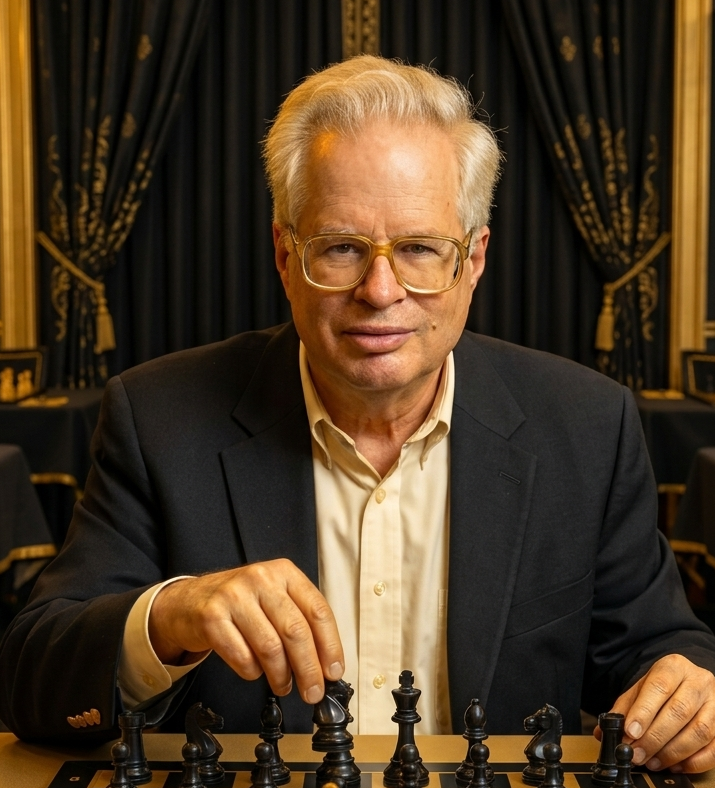
Mr. George Mirijanian, writing on behalf of the Wachusett Chess Club at Fitchburg State University (in US Chess' Post on the Facebook page), described Bill as the “No. 1 organizer of tournaments in the United States” and observed that no one else had accomplished as much during more than 65 years of involvement in American chess. It is difficult to disagree. Bill did not merely organize tournaments. He helped build much of the competitive structure through which generations of American players experienced the game.
For me, however, this loss is also deeply personal. Only three days before Bill passed away, I received what I can only regard as a divinely granted opportunity to speak with him one final time.
A formidable player who chose to create opportunities for others
Bill Goichberg was born on November 11, 1942, in New York. He graduated from New York University in 1963. According to a US Chess biographical account, he entered his first chess tournament in 1961 after reading every chess book he could find in the Mount Vernon, New York, public library, together with every column of Modern Chess Openings—9.
His initial US Chess rating was 1940, and within approximately three years he had reached 2200. He ultimately became an Original USCF Life Master and a FIDE Master, reaching a peak FIDE rating of 2530 in July 1978.
Bill’s accomplishments as a player are sometimes overshadowed by the magnitude of his organizing career. Yet he was a formidable competitor. He recorded a plus score at the prestigious Lone Pine tournament in 1974, won a round-robin Futurity ahead of two International Masters in 1976, won the Toronto Open and Montreal Open, and missed an International Master norm by only half a point at Gausdal, Norway, in 1978. He was also a US Chess National Tournament Director and a FIDE International Arbiter.
Perhaps Bill’s most historically significant competitive contribution came away from the board. He served as the non-playing captain of the United States team that won the gold medal at the 1976 Chess Olympiad in Haifa, Israel - at that time, the country’s only Olympiad team gold medal in the preceding half-century.
Nevertheless, Bill devoted the greater part of his life not to advancing his own playing career, but to creating opportunities for others.
The architect of modern American tournament chess
Bill organized his first tournament, the New York City Junior, in 1964. That same year, he established what was initially known as the New York City Chess Association. As its activities expanded beyond New York, it became the Continental Chess Association in 1968.
The CCA’s historical record documents more than 2,000 tournaments held across 26 states and more than $13 million awarded in prize money. For many years, more players competed in CCA tournaments than in those of any other organizer in the United States.
The numbers are impressive, but they do not fully express Bill’s influence. His greater contribution was his willingness to challenge accepted assumptions about how chess tournaments could be organized.
In 1966, he pioneered US Chess-rated scholastic tournaments when many people believed children would not participate in rated events or pay federation membership dues. The Greater New York Scholastics held in December of that year attracted 614 players - more than twice the previous national attendance record - and generated approximately 400 new US Chess members.
Bill went on to originate several events that became foundational institutions of American scholastic chess:
- The National High School Championship in 1969
- The National Junior High School Championship in 1973
- The National Elementary School Championship in 1976
- The National Scholastic K–12 Grade Championship in 1991
Today, thousands of children participate in these championships without necessarily knowing that the opportunities available to them can be traced back to Bill’s determination and foresight.
His innovations extended far beyond scholastic chess. He introduced US Chess-rated quad tournaments in 1969, grouping four players of similar strength into round-robin sections. In 1973, he pioneered non-smoking chess tournaments despite predictions that the policy would reduce attendance. What was initially controversial ultimately became the accepted standard.
That same year, Bill created the World Open. Its inaugural edition offered a $15,000 guaranteed prize fund - 50 percent greater than that of any previous American open tournament - and attracted more than 700 players. The World Open became one of the most recognized and enduring events in international open chess. The 1986 edition drew 1,506 players, recorded by CCA as a world attendance record for an open tournament.
Bill also created opportunities for ambitious American players to earn international titles. Beginning in 1977, CCA organized Swiss Internationals and Swiss Futurities offering FIDE rating and title-norm opportunities. According to CCA’s records, approximately half of the Americans who earned International Master or Grandmaster titles between 1977 and 1993 obtained at least one norm in a CCA International.
Other innovations associated with Bill and CCA included the US Chess Grand Prix, rated beginner opens, alternate playing schedules, multiple time-control options, and practical use of time-delay clocks to resolve certain sudden-death claims objectively. Ideas that initially appeared unconventional were frequently adopted by other organizers and eventually became ordinary features of American tournament chess.
Bill Goichberg organized thousands of tournaments throughout the United States. Photo: U.S. Chess Federation, reproduced in the Chess.com memorial article.
Service at every level of US Chess
Bill’s service to the United States Chess Federation was equally remarkable.
He worked as the federation’s Rating Statistician from 1964 through 1967, during a period when ratings were still calculated largely by hand. He served as co-editor of Chess Life in 1966 and was elected to the federation’s Policy Board - now the Executive Board - on three separate occasions.
He volunteered extensive time to help prepare the fourth edition of the Official Rules of Chess, published in 1993. He became US Chess Office Manager in late 2003 and was appointed Executive Director in 2004, agreeing to serve without compensation while the organization faced serious financial difficulties.
Bill was elected President of US Chess in 2005 and reelected in 2007, completing his service in that role in 2009. His work as a player, organizer, director, editor, administrator, policymaker, and federation leader meant that he had served American chess from virtually every possible direction.
In 2018, Bill was inducted into the U.S. Chess Hall of Fame. The Hall of Fame announcement appropriately recognized him as a great innovator whose influence on American tournament play was unique.
Many important aspects of his generosity were not widely publicized during his lifetime. Following Bill’s passing, David Hater recalled that Bill quietly provided free tournament entries to promising players who needed assistance. Some later became prominent Grandmasters. Bill apparently did not seek public recognition for helping them.
This was consistent with the man many of us knew: direct, practical, observant, sometimes reserved, and far more concerned with what needed to be done than with receiving credit for doing it.
How Bill Goichberg changed the course of my own work
My relationship with Bill developed at the intersection of chess, parenthood, tournament organization, and technology.
For many years, I accompanied my son, Prashantha Amarasinghe, to major tournaments organized by the Continental Chess Association (CCA). Prashantha later became a US National Master. He was among the players tied for first place at the 2010 National High School Championship and, in December 2011, tied for first at the National Youth Action Championship West in Irvine, California. We owe much of Prashantha’s development and accomplishments as a chess player to the exceptional opportunities CCA provided for aspiring young American players to compete regularly in strong, comprehensive, and highly competitive tournaments.
During one of our trips to the CCA World Open in Philadelphia, I found myself thinking that there should be a more effective and automated way to handle online chess-tournament registration. I was also directing and organizing tournaments in Minnesota, and I began developing a specialized registration system to address problems I had encountered as an organizer.
Somehow, that developing system attracted Bill’s attention.
On one occasion, I called him regarding a hotel-registration issue while preparing to take Prashantha to a CCA tournament. Bill was traveling and answered the call from his car. After providing the information I needed, he unexpectedly told me that he was interested in using my registration system for his tournaments.
I was pleasantly surprised and asked how he had learned about it.
Bill was a man of relatively few, but meaningful, words. His response was characteristically brief:
“I pay attention.”
During the 2012 World Open, Bill called my hotel room and asked to meet with me to discuss using the system for CCA tournaments. His interest persuaded me to develop what had been an internal system into a professionally supported registration service for other chess organizers.
Within a few weeks, my Lead Engineer and I worked intensively to prepare OnlineRegistration.CC for broader use. Continental Chess Association became its first major customer.
The professional relationship that followed was a true collaboration. Bill and experienced CCA Tournament Directors including, Mr. Steve Immitt, Mr. Bob Messenger, and Mr. David Hater contributed numerous practical suggestions and feature requests. Their demanding real-world requirements substantially strengthened and advanced the platform. We also established ChessAction.com as a CCA-focused white-label registration site displaying only Continental Chess tournaments.
Bill told us on several occasions that he sincerely did not know what he would have done without the registration system. Those words meant a great deal to me, particularly coming from someone with his extraordinary knowledge of tournament operations.
The importance of this history, however, is not the technology itself. It is what the experience revealed about Bill. He noticed useful work, even when it was being done quietly and on a relatively small scale. He gave a new idea a serious opportunity. He provided candid feedback, expected practical results, and remained committed to a solution that served his players and tournament directors well.
The CCA relationship continued for approximately fourteen years. Even as Bill’s health made him less accessible during recent times, Continental Chess continued using our tournament-registration service.
A final telephone conversation
During the last few years, I understood that Bill was facing significant health challenges. He had become increasingly difficult to reach, and we were not able to communicate as frequently as before.
On Thursday, July 30, 2026, I suddenly felt that I should call him.
I did not have much hope that I would reach him or that he would be able to speak. Nevertheless, I placed the call.
To my surprise, Bill recognized my number and answered the telephone. He sounded down and told me that he was at home but expected to receive further treatment within the next day or so. Despite how he was feeling, he was kind, gracious, and genuinely appreciative that I had called.
Only three days later, on Sunday, August 2, Bill departed this life.
I am profoundly grateful that I followed the impulse to call him. I cannot adequately explain the timing. I can only receive it as a divine intervention - a final opportunity to hear his voice, express my concern, and speak with him before his departure.
That brief conversation has now become one of my most treasured memories of Bill.
An enduring legacy
The response from the chess community since Bill’s passing demonstrates the breadth of his influence. Players remember tournaments that shaped their childhoods, title opportunities that advanced their careers, and events that brought together generations of competitors. Organizers and tournament directors remember the standards he established. American Grandmasters have acknowledged that their own careers—and the larger professional chess environment in this country—benefited directly from the opportunities he created.
Bill’s legacy is not confined to a list of offices, titles, innovations, or attendance records. It lives in the countless players who entered their first rated tournament because he believed scholastic chess could succeed. It lives in the Masters who earned norms at events he created. It lives in the World Open and the many other tournaments that became annual traditions for chess families. It lives in the organizers who adopted ideas he first had the courage to test.
Before his passing, Bill entrusted the administration of Continental Chess Incorporated to its trustees. The organization has announced that CCA will continue operating in accordance with his wishes and as an enduring part of his legacy.
I extend my heartfelt condolences to Bill’s family, to the trustees and tournament directors of Continental Chess Association, to his longtime colleagues and friends, and to the entire US Chess community.
When I think of Bill today, I return to the few words he spoke to me many years ago:
“I pay attention.”
Indeed, he did. Bill paid attention to the needs of players, to the future of scholastic chess, to the development of aspiring Masters, to the practical challenges faced by organizers, and to ideas that could make the game stronger.
American chess is immeasurably richer because he paid attention.
Thank you, Bill, for everything you gave to chess—and for the opportunity and confidence you extended to me. You will be deeply missed, but the institutions you created, the opportunities you opened, and the lives you influenced will continue to carry your legacy forward.
May you rest in peace, Bill.
Acknowledgments and principal sources
This remembrance incorporates my personal recollections of Mr. Bill Goichberg and the history of the working relationship between Continental Chess Association and OnlineRegistration.CC.
Biographical and historical details were verified through:
- US Chess: “Bill Goichberg (1942–2026)”, published August 3, 2026
- Continental Chess Association’s announcement and continuation statement
- Continental Chess Association history
- US Chess’s 2004 biographical announcement appointing Bill Goichberg Executive Director
- US Chess’s 2018 U.S. Chess Hall of Fame announcement
- Chess.com: “Bill Goichberg (1942–2026)”, published August 4, 2026
- US Chess Facebook memorial post, including the remembrance contributed by George Mirijanian